
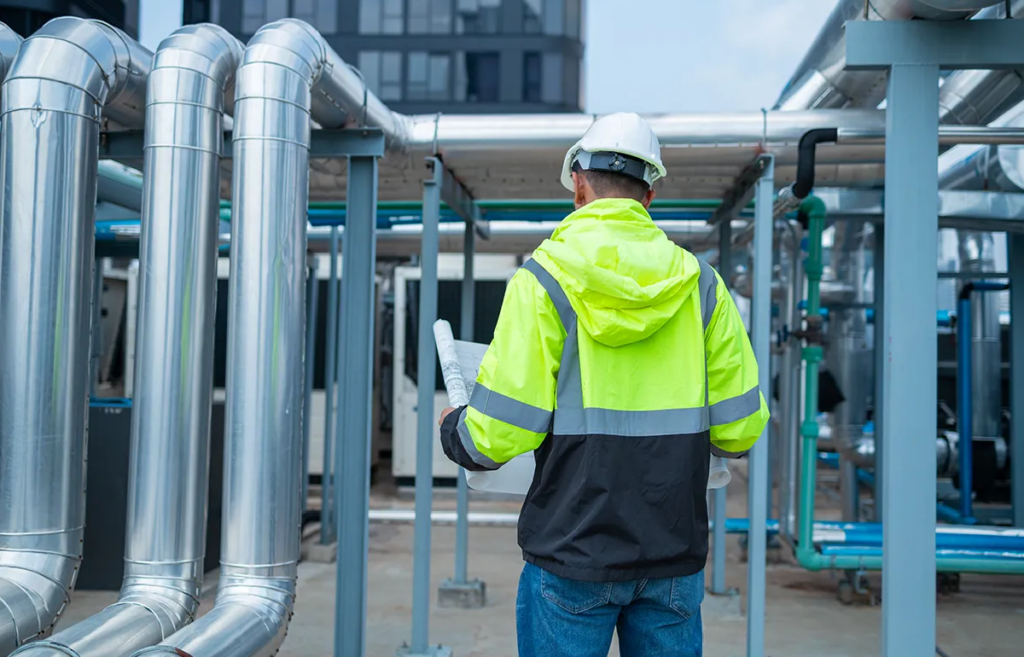
Safety directors and managers are responsible for designing and managing the health and safety programs of a company. The aim is to equip workers with the knowledge and training to reduce accidents and to know how to navigate unsafe conditions.
The safety director plays a pivotal role in mechanical construction. Without it, companies risk higher rates of injury and illness.
Let’s take a look at why this kind of work comes with so many risks and what safety directors do to ensure that workers are protected (and why it matters for the people who hire them).
Why a Safety Director Is Necessary
Some industries are at higher risk for injury than others. Because of the nature of the work we do — from custom metal fabrication to commercial HVAC — our industry rate of incidence is relatively high.
According to the U.S. Bureau of Labor Statistics, the rate of non-fatal occupational injuries and illnesses in the HVAC and plumbing industry is 3%. So, for every 100 full-time workers, there are 3 recordable cases of injury or illness every year.
What’s more, 1.7% of these cases result in loss of work. 1.1% of injured employees require time off of work to recover whereas 0.6% end up transferring jobs as a result.
As for why the injury rate is so high in our industry, there are many risks, including:
- Wet surfaces
- Electrical hazards
- Chemical exposure
- Weather events (e.g. extreme temperatures, storm exposure, etc.)
- Improper use of personal protective equipment
These can result in a variety of injuries like slips and falls, physical strains, broken bones, electrical shock, toxin exposure as well as serious illness.
While HVAC and plumbing professionals receive extensive training on safety during their education, it’s not always enough. It also doesn’t get into all the nuances of occupational safety. This is why a safety director is a critical role in our type of work.
What Does a Safety Director Do?
To start, a safety director is uniquely qualified for the job they perform.
Typically, they have a Bachelor’s degree or higher in an area like Occupational Health or Environmental Science. And if they work in HVAC and plumbing, they have many years of experience in construction.
They’re also going to have certifications like:
- OSHA 300 or 500
- NFPA (for fire and life safety)
- Associate (ASP) or Certified Safety Professional (CSP)
As for what they do, here’s what they’re responsible for:
Manage Documentation
- Maintain all safety documentation for the company. This includes job site policies, training procedures, inspection protocols, and more.
- Write up a safety plan that outlines common hazards workers will encounter on the job and the practices to follow in order to minimize risk.
Provide Training
- Train job site supervisors on accident prevention and what to do in case of an accident or emergency.
- Provide ongoing training to workers on proper job site practices.
- Perform new hire training on safety awareness and company protocols.
Keep Track of the Safety Record
- Keep a record of all managers and employees who have completed safety – and health-related certifications.
- Report all accidents to management.
- Ensure that accidents are logged with OSHA and local safety regulatory agencies.
Promote Good Safety Practices
- Stay on top of the various safety, health, and environmental compliance requirements for the HVAC and plumbing industry.
- Create and post promotional materials around the office.
- Investigate accidents and provide corrective measures and updated training to mitigate those risks in the future.
Evaluate and Improve Your Protocols
- Complete job safety analyses to assess the risks and hazards of a particular work environment before entering it.
- Inspect the company’s tools and PPE to ensure workers are fully protected whenever they step on a job site.
- Audit the company’s accident history, including injury and illness rates as well as any notable trends in risks or lack of compliance.
Protect Your Workers
- Serve as the main point of contact for anyone with concerns about safety and health hazards on job sites.
- Work with HR to manage injury or illness claims and workers compensation.
How Dean E. Norris Makes Safety a Top Priority
The Safety Director plays a pivotal role in mechanical construction. By proactively preparing for the worst-case scenario, they actually help minimize risks and associated injuries.
What’s more, the companies who contract these safety-minded organizations reap the benefits, too. Organizations that are able to maintain an experience modification rate (EMR) below 1.0 won’t have to spend as much money on insurance or workers’ compensation. These savings can then be passed onto their customers.
At Dean E. Norris, the health and safety of all our workers is paramount. To learn more about what we’re doing to keep everyone safe, learn more about Safety at Dean E. Norris.