
So you’re having problems with a piece of commercial HVAC equipment. What’s your next move? Will a repair do the trick or is it time to replace it?
There are a number of factors that come into play when deciding what to do with commercial HVAC systems that are underperforming or stop working. Let’s take a look at some questions that can help you decide if it’s better to repair or replace your commercial HVAC.
7 Questions to Answer If Your Commercial HVAC Isn’t Working
Commercial air conditioning and commercial heating systems not only need to be operational, they need to perform at the highest level. If they can’t do that, then your building is going to suffer consequences like:
- Uncomfortable tenants
- Damaged products or equipment
- Poor air quality
- Dangerous work conditions
- Loss of productivity
- Higher HVAC costs over time
- Service interruption/revenue loss
Both a repair and replacement can help you resolve the issues you’re dealing with. However, an HVAC replacement sometimes makes more sense than another repair. Here’s how you’ll decide:
Q1: What are the signs your HVAC isn’t working?
The first thing to examine is the nature of the problem. Is it something minor like a clanging noise that just started yesterday? Or is it something major like repeated breakdowns that keep your building feeling hot and muggy no matter what you do?
Minor and one-time issues can often be repaired. But if you’re having significant trouble with your HVAC system and it’s affecting other areas of your business, a replacement is likely in order.
Q2: How old is the equipment?
With this question, it’s not so much about the number of years the equipment has been in service. Instead, consider the following:
- The overall condition of the equipment (not just the problematic part)
- How heavily it’s been used
- The kind of environment it operates in
- How many times it’s been repaired
- If it receives regular preventative maintenance
HVAC equipment is like our bodies. Even if it runs in harsh environments, proper maintenance can help it last longer. So, the age of the equipment alone won’t necessarily tell you if it needs to be retired.
Look at how old the system is behaving. If it’s inefficient, breaks down frequently, and is generally unreliable, it probably needs to be replaced.
Q3: When was it last repaired?
Even if you’re looking at a major repair, that doesn’t spell its doom. What’s a more telling sign is how frequently the part or system has been repaired.
Take a look over your HVAC service history. How many times have you had this particular issue inspected in the last year? If it’s more than twice and you’re experiencing major operational disruption because of it, another repair is only going to delay the inevitable. It will likely cost you more in the long run, too.
Q4: Is your system energy efficient?
Have you compared your energy bills over the last year? If the number keeps creeping up while you pay for numerous HVAC repairs, it’s going to be much more cost-efficient to replace the old equipment with something that’s up to the task.
Energy efficient HVAC systems don’t have to run or work as hard as older, inefficient ones. This helps keep your utility bills low.
What’s more, they create more reliable and comfortable commercial environments. You probably have enough headaches to deal with in managing your facility. An energy efficient HVAC system shouldn’t be one of them.
For example, we opted to replace the older heating water pumps, steam heat exchanger, and chilled water pumps at WSU Ablah Hall. The new equipment provided a more reliable and efficient HVAC system for the building, which increased the comfort of everyone who worked and studied there.
Q5: Are parts, refrigerant, etc. still available for this piece of equipment?
You might be looking at the faulty part or equipment and thinking, “It’s got some more months or years in it”. But if your HVAC contractor goes to buy replacement coolant, parts, or other components and they’re not readily available or cheap, then the equipment has likely reached the end of the line.
When manufacturers have deemed everything else about it obsolete, it’s more cost-effective to purchase new equipment that can easily and quickly be serviced.
Q6: How does the cost of the repair compare to a new piece of equipment?
If the other questions have you suspecting it’s time to replace your commercial HVAC equipment, contact your HVAC partner.
Ask them for an estimate to repair as well as to replace it. If you’ve scheduled multiple repairs this year or expect more to come, add those costs to the estimate for this repair. How does it stack up against the cost to replace the unit?
In general, if the cost to repair your HVAC system is about 30% or less of the cost to replace, the repair makes the most economical sense. Anything more and the replacement will end up saving you money in the long run.
Q7: Has your business been impacted by it?
Whether this is a one-time issue or a repeat offender, it’s a good idea to take a bird’s-eye view of the problem before you make your decision.
What you want to look for is how this faulty or broken part has impacted your business productivity, profitability, and even safety. If you’re seeing significant side effects and they’ve lasted more than a day, replacing the equipment is probably the right move.
When we put in the new cooling system at CMF Foundry, this was one of the primary goals. By installing more durable and corrosion-resistant equipment, it would both improve overall performance and minimize downtime.
Signs It’s Time to Replace vs. Repair Your Commercial HVAC
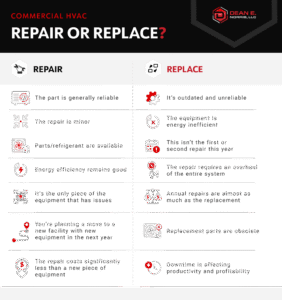
To sum up, here are the signs it’s time to repair or replace your HVAC.
Next Step: Schedule an Inspection
You don’t have to decide if your commercial HVAC should be repaired or replaced alone. Give us a call at 316-688-1901 or fill out our contact form to schedule an on-site inspection. We’ll help you weigh the pros and cons.